Lean manufacturing is about delivering what customers value and removing everything that doesn't add value. Toyota formalized the approach in the mid-20th century, and manufacturers have used its tools ever since to cut waste, shorten lead times, and lift quality. Most operations leaders already know the theory; the real work is putting it into daily practice on the shop floor, where shift handoffs, multilingual teams, and scattered communication channels quietly erode gains.
This guide walks through the core concepts, the eight wastes, the five principles, and the implementation moves that separate lean programs that stick from the many that quietly stall out.
TL;DR
- Lean manufacturing eliminates waste and maximizes customer value, but most rollouts stall without strong communication and leadership.
- The eight wastes (including non-utilized talent) cost manufacturers real dollars across production, quality, and retention.
- The five lean principles only work when frontline workers understand them and are equipped to act.
- Communication is a lean prerequisite, not an afterthought, and most rollouts quietly break at shift handoffs when updates don't reach every worker.
- SMS-based platforms like Yourco close the communication gap that stalls most lean rollouts.
What is Lean Manufacturing?
Lean manufacturing is built on one idea: the only work worth doing is work the customer values. Everything else is waste to be found and eliminated. Three pillars hold the approach together.
Waste Elimination
Waste elimination means finding and removing anything that doesn't add customer value, from overproduction and waiting time to defects and non-utilized talent. The Japanese term for this is “muda”. NIST MEP lean programs have helped manufacturers save an average of 20% of the time, effort, or costs tied to their production processes by working through these categories one at a time.
Continuous Improvement (Kaizen)
Continuous improvement, or kaizen in the Toyota Production System, is what keeps lean moving. Operators and executives alike look for small ways to make the work better every day, using structured problem-solving cycles (Plan-Do-Check-Act) rather than one-off projects. Former Danaher Group executive Art Byrne has argued that lean's real strategic value is lead time reduction and customer reliability; cost savings are a byproduct. Teams that treat lean as a pure cost-cutting program tend to claim early wins, then slide back when pressure returns.
Value Creation
Value creation is the point. Understand what customers actually want, deliver exactly that, and charge only for that. Anything the customer wouldn't pay for is a candidate to remove. As waste disappears, processes simplify, and teams move faster.
The 8 Wastes of Lean Manufacturing
Waste, or muda, is anything that doesn't add value from the customer's perspective. The original seven classic types have been extended to eight, with the eighth especially relevant for operations managers running frontline teams.
1. Overproduction
Overproduction happens when output exceeds demand or arrives before it's needed. Taiichi Ohno, architect of the Toyota Production System, called it the most dangerous waste because it triggers most of the others: excess inventory, extra handling, and hidden quality problems. It consumes materials early and covers up downstream inefficiencies. On the floor, overproduction usually traces back to forecast-driven scheduling, long changeovers that push operators to run big batches, or incentive systems that reward output over flow.
2. Waiting
Waiting waste is anywhere a worker, machine, or material sits idle. The Siemens True Cost of Downtime 2024 report found unplanned downtime costs Fortune Global 500 manufacturers an average of $253 million per facility per year. Planned waiting is just as costly over time: operators waiting on a supervisor's decision, materials waiting for a forklift, or a line waiting for a quality release. Understanding how to identify bottlenecks in manufacturing helps pinpoint where waiting waste is dragging production down.
3. Transport
Transport waste occurs whenever items move without gaining value. Some movement is necessary, but excessive transport risks damage, stretches lead times, and adds cost. One facility documented by IndustryWeek moved its loading docks next to the point of use and saw worker productivity climb more than 20%, with payback in under a year and no new equipment required. Layout changes of that kind often expose related waste elsewhere in the flow, since long transport paths usually introduce inventory buffers and rework loops.
4. Over-processing
Over-processing means doing more than the customer is willing to pay for: unnecessary precision, extra features, or redundant steps. It often shows up as inspections that could be replaced by better upstream process control. Another common form is documentation built for an internal audit cycle rather than for the process itself, in which operators fill out forms that nobody reads. Over-processing is easy to rationalize ("we've always done it this way") and hard to eliminate without clear definitions of customer value to test against.
5. Inventory
Excess inventory ties up cash and conceals problems. The IndustryWeek Best Plants 2024 Statistical Profile shows a median raw materials inventory of 30 days on hand, but the mean is 93 days, suggesting a subset of plants is carrying a large buffer stock that may be masking process issues.
6. Motion
Motion waste is every extra step, reach, bend, or search an operator performs. It slows people down and causes ergonomic injuries. The Lean Enterprise Institute documented one Toyota Georgetown associate with 152 motion and process problems in a single 30-foot workstation, a reminder of how fine-grained this work becomes in a mature lean environment.
7. Defects
Defects represent total waste: materials, time, and labor spent on a product that does not meet specifications. The 1‑10‑100 Rule illustrates how costs escalate if a defect is missed at each stage: roughly $1 to fix it at the point of creation, $10 if caught at inspection, and $100 after it reaches the customer. The cost of poor quality, which includes internal and external failures, ranks among the largest controllable expense categories in many manufacturing operations. Error‑proofing devices, first‑piece inspections, and clear standard work are practical tools that push defect detection upstream, where correction is cheapest.
8. Non-Utilized Talent
The eighth waste, not in Ohno’s original seven but now widely accepted, is the failure to use the knowledge, skills, and ideas of the people doing the work. According to the World Economic Forum’s Empowering Frontlines: Retaining, Training and Upskilling Industrial Workforce (2025), each frontline employee departure costs roughly $52,000 annually in recruiting, training, and onboarding, so underused talent is both an operational inefficiency and a retention risk. Operators usually know where the real problems are before management does; what’s missing is a reliable channel for that knowledge to reach people who can act on it.

The Five Principles of Lean Manufacturing
The five principles connect daily waste work to long-term transformation. Each builds on the last, forming a cycle that never closes because perfection is the goal, not the endpoint.
- Define Value. Understand what customers truly want and stop doing anything they won't pay for. The only valid definition of value comes from the customer.
- Map the Value Stream. Document every step in production to separate what adds value from what doesn't. Value stream mapping is also becoming a useful precursor to automation and AI planning, since it shows which processes are stable enough to automate and which still need fixing.
- Create Flow. Smooth production by reorganizing workspaces, reducing batch sizes, and balancing workloads. Flow needs predictability first: scheduling chaos has to be addressed before flow can take hold. See how combining Six Sigma and Lean Manufacturing reinforces this work.
- Establish Pull. Produce only when demand signals it. Pull systems, such as kanban, cut inventory and block overproduction. Dell's build-to-order model is a well-known example of pull at scale.
- Pursue Perfection. Encourage everyone to contribute and keep refining. Toyota’s Georgetown plant has dramatically reduced the physical footprint of its final assembly operations while maintaining steady production volume, built through thousands of small incremental kaizen cycles rather than a single large‑scale redesign.

How to Implement Lean Manufacturing
Lean takes a structured approach and organization-wide commitment. Most rollouts struggle, and practitioners widely agree that the causes are rarely technical. Three communication breakdowns recur as the usual culprits: no clear vision shared with workers, weak stakeholder engagement, and feedback loops that are too slow to correct problems. The strategies below address the most common failure modes.
Secure Leadership Commitment
Leadership buy-in is the difference between lean that sticks and lean that fades. The signal that matters most is presence. Leaders who walk the floor regularly (what lean practitioners call a gemba walk), engage with the work, model problem-solving, and set the tone that nothing else can replace. Lean culture is built through sustained leadership behavior over years, not training events or one-time consultant engagements.
Train the Floor on Lean Tools
Tailor training to different staff levels, back classroom learning with on-the-job coaching, and appoint internal lean champions. Cross-train employees on core tools (5S, kanban, value stream mapping, and error-proofing) so the floor can contribute to improvement, not just comply. Strong SOP compliance across shifts protects the gains once they're in place.
One structural element consistently separates effective lean organizations: roughly one frontline team leader for every five or six associates. Without that ratio, no one has the time to coach workers back to standard when drift happens.
Start With a Pilot Before Scaling
Pick small-scale pilot areas with clear goals and metrics, capture lessons learned, and use the results to build buy-in for a broader rollout. Visible wins in the first six months sustain momentum; projects that drag on without results generate skepticism instead.
A common trap is running kaizen events, identifying 15 problems, then moving on before fixing any of them. Improvements stick when teams refuse to start anything new until the last thing is done. Johnson Controls showed what focused execution looks like at scale, reporting a 24% productivity gain in nine months.
Track the Right Metrics
Align metrics with lean goals, balance leading and lagging indicators, and use visual management boards so the floor can see performance in real time. Useful KPIs include on-time delivery, first-pass yield, inventory days on hand, and overall equipment effectiveness (OEE). Labor productivity metrics are worth tracking too, since they reveal whether wasted work is actually freeing capacity.
The trap to avoid is tracking lean activity instead of lean outcomes. Counting kaizen events completed or 5S audits run tells you lean is happening. It doesn't tell you whether it's working.
Build a Communication Infrastructure
Communication is a lean prerequisite. Roughly 40% of plant incidents happen during changeovers, when shift-to-shift information transfer is most fragile. When workers can't reliably access process updates, standard work changes, or quality alerts, the standards set on one shift deteriorate by the next shift. Clear shift-change communication is where most lean rollouts quietly break.
The cost of communication gaps shows up in missed output. According to a Yourco-commissioned survey of 150 HR leaders, 56% report their company has missed vital deadlines because they couldn't reach a frontline employee in time, the exact failure mode that erodes lean performance on the floor. The flip side is just as clear: in the same survey, 93% of HR leaders said better communication tools can lift productivity.
Use multiple channels (visual displays, shift huddles, and digital platforms) to push real-time updates, open feedback loops, and lift engagement. For multilingual workforces, translation support and solutions to overcome language barriers ensure every worker can participate. SMS-based platforms like Yourco reach every worker on the floor, including those on basic flip phones, so shift updates, standard work changes, and safety alerts land with the people actually running the process.
Close the Communication Gap That Stalls Lean Rollouts With Yourco
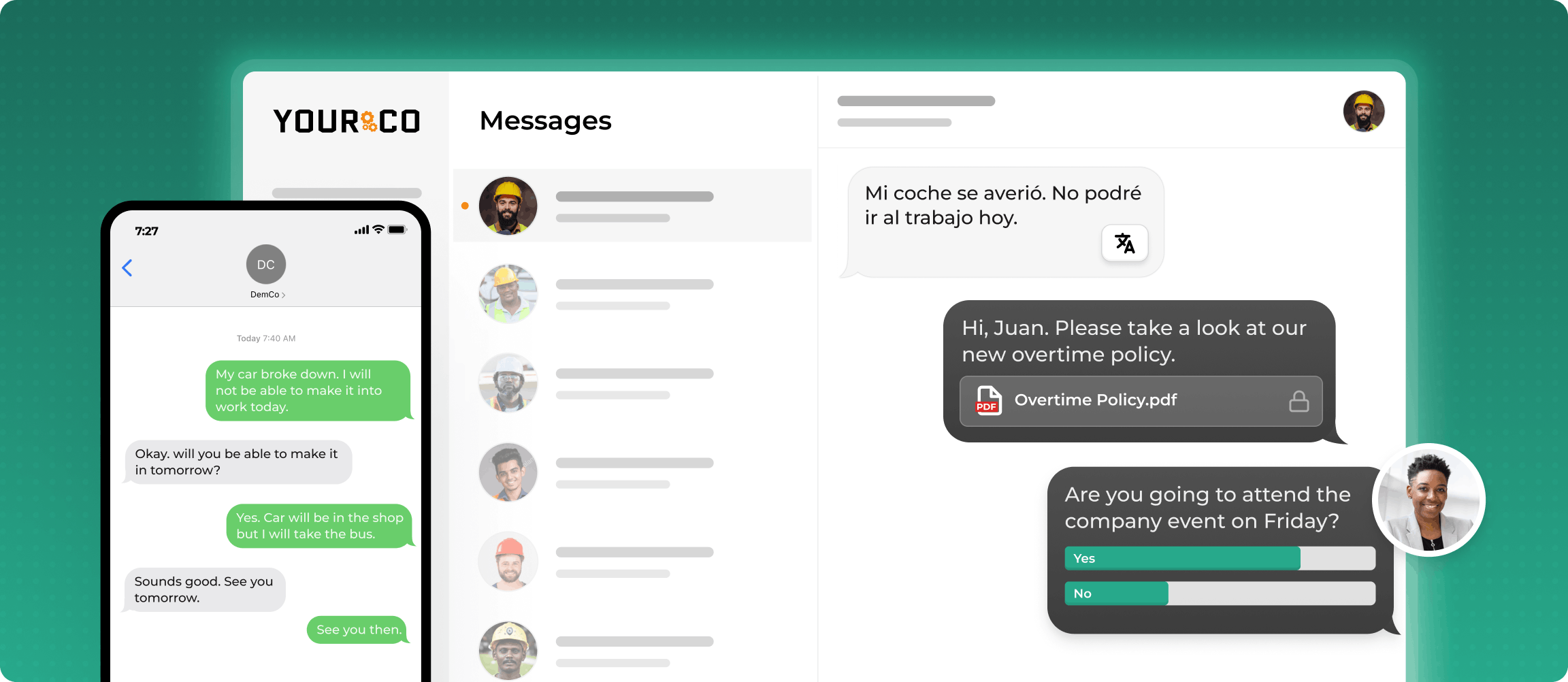
Lean manufacturing succeeds or fails on whether the people closest to the work have the information they need to act. Yourco is an SMS-based employee communication platform built for frontline teams, connecting operations leaders to every worker on the floor without an app, email, or Wi-Fi.
- SMS to any mobile phone, including basic flip phones, with no app download required
- Two-way messaging so operators can surface issues, ask questions, and confirm standards
- AI-powered translations in 135+ languages and dialects
Yourco syncs with 240+ HRIS and payroll systems via open APIs, keeping contact lists, shift groups, and job data automatically up to date. For multi-site operations, Enterprise Bridge enables one-way broadcasts from corporate leadership to the entire frontline, keeping every location aligned without requiring responses.
Frontline Intelligence gives operations teams centralized visibility into production communication patterns across all locations. Leadership can see which sites respond fastest to safety alerts and standard work changes, track acknowledgment rates for kaizen updates by plant or shift, and spot disengagement signals before they show up as defects or turnover.
"We have tried 3 text communication tools, and this is the best experience we've had by far. A consistent line of communication to our employees is one of the most important things, and Yourco is the most reliable system around."
Terri Kasper, HR Manager, Calumet Carton Company
After 90 days on Yourco, companies see two-way employee engagement reach 86%, the kind of sustained participation lean rollouts depend on shift after shift.
Try Yourco for free today, or schedule a demo to see the difference the right workplace communication solution can make for your company.

Frequently Asked Questions About Lean Manufacturing
What is lean manufacturing in simple terms?
Lean manufacturing is a production approach focused on delivering exactly what customers value and removing everything else. In practice, it means finding and cutting waste, including overproduction, waiting, defects, excess motion, extra inventory, over-processing, and non-utilized talent, so every step in a process adds value.
What are the 7 wastes of lean manufacturing, and what is the 8th?
The original seven, often remembered with the acronym TIM WOOD, are Transport, Inventory, Motion, Waiting, Overproduction, Over-processing, and Defects. A widely adopted eighth waste is Non-Utilized Talent: failing to use the knowledge and ideas of the people doing the work. For operations managers, it is often the most expensive because it drives avoidable turnover and rework.
Why does lean manufacturing fail so often?
Lean failures usually trace back to communication breakdowns: a lack of a clear vision shared with workers, weak stakeholder engagement, and slow feedback loops. Lean also fails when it's treated as a project with an end date rather than an operating culture, because improvements made during a kaizen event drift back within weeks if they aren't reinforced.
How do you get buy-in for lean on the shop floor?
Floor buy-in comes from three things: visible leadership presence, early wins workers can see and feel, and a genuine channel for workers to surface problems without reprisal. Operators usually know where the waste is; lean succeeds when management gives that knowledge a path to be heard and acted on.
What KPIs should you track for lean manufacturing success?
Useful lean KPIs balance leading and lagging indicators. Core metrics include on-time delivery, first-pass yield, overall equipment effectiveness, inventory days on hand, and defect rate. Tracking acknowledgment rates and response times on shift-level communications also shows whether lean standards are actually reaching the floor.
Does lean manufacturing lead to layoffs?
Lean manufacturing is not about cutting headcount. The goal is to redeploy capacity freed by eliminating waste into more valuable work, such as shorter lead times, higher quality, and increased new product volume. Organizations with strong lean cultures usually see lower, not higher, voluntary turnover.
How does communication fit into lean manufacturing?
Communication is the infrastructure on which Lean depends. Shift handoffs, training changes, and quality alerts break down when information doesn't reliably reach every worker. SMS-based platforms like Yourco deliver standard work updates, kaizen outcomes, and safety alerts to any mobile phone, so problems surface before they compound and improvements stick across shifts.