The accommodation and food services sector has a quarterly quit rate of 4.2%, nearly twice the total private-sector average, according to BLS JOLTS data. Harvard Business Review research found that up to 20% of that turnover happens within the first 45 days, making onboarding the single highest-leverage retention intervention available. This 15-step checklist shows you exactly how to onboard hospitality staff who stick around and perform well, with specific actions you can implement immediately.
TL;DR
- Hospitality turnover is expensive: replacing a single restaurant worker costs approximately $6,000, making structured onboarding the highest-leverage retention tool available
- Handling paperwork and role clarity before day one removes friction before a single shift is worked
- Safety, food-handling, and chemical training are priorities that many employers address on the first day of employment
- Multilingual communication is non-negotiable for hospitality: most kitchen and housekeeping roles have significant non-English-speaking populations
- Structured 30/60/90-day check-ins and a buddy program are the two steps most directly linked to improved 90-day retention
- SMS-based platforms like Yourco deliver welcome messages, training, safety alerts, and two-way confirmation to every frontline worker on any phone, no app required
Pre-Hire Setup
Pre-hire setup is the foundation of effective hospitality staff onboarding. Getting paperwork and role clarity handled before day one means new hires arrive confident rather than confused.
1. Pre-Arrival Communication and Paperwork
Goal: Handle paperwork before day one so new hires walk in confident and prepared
Nothing kills confidence faster than scrambling through forms during the first shift. Start with a simple text message listing exactly what you need:
- I-9 and W-4 forms
- Direct-deposit information
- Food-handler permits and alcohol-service certifications
- Any state or union documents
A welcome text to a new employee sent before day one sets the right tone and reduces first-day confusion. For a detailed guide on how new hires complete and submit required paperwork entirely via text, including I-9 forms and direct deposit, see the guide on submitting required documents to HR via text.
A note on I-9 timing: Many employers follow USCIS Handbook M-274 guidance, under which Section 1 is completed on or before the first day of employment, and Section 2 is completed within 3 business days. Missing this window is one of the most common employer errors in hospitality onboarding.
Approximately 80% of frontline workers lack a corporate email address, according to Emergence Capital's deskless workforce research, while 91% of U.S. adults now own a smartphone, according to Pew Research's 2025 survey. Text messaging is the one channel you know reaches them. You can schedule text reminders for anyone who hasn't responded, which also prevents no-shows.
Action Steps
- Send a digital welcome packet via SMS (property map, first-week schedule, break-room basics)
- Let employees text photos of completed forms to your company number
- Include answers to common first-day questions
- No portals or passwords needed: just click and read
2. Role Clarity and Job Expectations
Goal: Define exactly what each job looks like to prevent confusion
Most new hires leave their first week with more questions than answers, and the gap almost always starts with unclear expectations about what the role requires day to day.
Core Responsibilities by Role
- Front-desk agents: Greet guests, handle reservations, process payments
- Housekeeping staff: Clean rooms, restock amenities, flag maintenance issues
- Food-service hosts: Manage tables, control wait times, assist servers
Action Steps
- Create role-specific checklists and text them before day one
- Include uniform requirements, start times, and first-shift goals
- Send daily objective texts during shifts ("Focus on upselling desserts tonight")
- Enable two-way texting so employees can ask quick questions in their preferred language
First-Day Essentials
The first day sets the tone for whether a new hospitality hire stays or becomes part of the revolving door. Front-loading clear standards, safety knowledge, and genuine support on day one directly addresses the early-turnover window.
3. Uniform and Grooming Standards
Goal: Professional appearance that builds guest trust from day one
Clear dress-code standards eliminate guesswork and help new hires feel prepared. Text each new hire a simple uniform guide tailored to their role.
Uniform Guidelines
- Front-desk staff: Blazers, pressed slacks, closed-toe shoes, visible name tags
- Housekeepers: Breathable polos, knee-length shorts or trousers, slip-resistant footwear
- Kitchen and bar crews: Chef whites or black server shirts with aprons, hair restraints and non-slip shoes
Grooming Checklist: Hair tidied and pulled back if it touches the collar; neutral jewelry; tattoos covered unless brand guidelines allow; unscented or light fragrance; fresh hygiene each shift.
Pro Tip: Take photos of properly dressed team members, store them in a cloud folder, and share the link via SMS. Use AI translation to send these standards in multiple languages and keep instructions clear across your team.
4. Property Tour and Facilities Orientation
Goal: Prevent confusion and ensure safety knowledge from day one
Essential Tour Stops
- Lobby, guest corridors, restaurant, staff areas
- Break room, storage closets, loading dock
- Safety equipment: fire extinguishers, first-aid kits, emergency exits
Send a property map via text before the shift starts, include links that open directions on any phone, and get thumbs-up confirmation once the tour is complete.
5. Guest Service Protocols
Goal: Consistent service standards that create memorable experiences
New hires should master service fundamentals quickly: greeting guests by name within 5 seconds, maintaining eye contact, and following a clear service recovery process: apologize, own the issue, fix it, and follow up.
SMS Reinforcement
- Send brief scenarios, such as "A guest's room isn't ready at check-in: what's your response?"
- Follow up with ten-minute floor practice sessions
- Use polling to confirm understanding across the team
6. Safety and Emergency Procedures
Goal: Keep both guests and staff out of harm's way
A clear safety routine protects everyone and supports compliance requirements. Start with four essentials: fire safety, medical emergencies, severe weather, and security threats.
Many employers follow OSHA's Hazard Communication Standard to ensure that training on cleaning products and chemical hazards is part of the initial onboarding process. For housekeeping personnel, bloodborne pathogens training is commonly addressed at the time of assignment. OSHA publishes training resources in 16 languages, including Spanish, Vietnamese, Tagalog, and Mandarin, worth incorporating directly into your safety materials.
Training Requirements
- Walk recruits to each alarm pull, first-aid kit, and storm shelter
- Explain how to report accidents, injuries, or near-misses
- Keep the process simple: quick call to manager, written incident log, SMS confirmation for timestamped records
- Use incident report templates for consistency
SMS alerts reach every employee in seconds and can be sent in multiple languages, including Spanish, Tagalog, or Mandarin.
This information is for general awareness only. For specific compliance guidance, consult with qualified legal professionals.
Department-Specific Training
Department-specific training for hospitality staff onboarding ensures new hires can meet the operational and regulatory requirements of their role, not just those of the property as a whole.
7. Food Safety and Handling
Goal: Protect guests and maintain health department standards
Essential Training Points
- Safe temperature controls for storage, cooking, cooling, and reheating
- Cross-contamination prevention through clean surfaces, color-coded boards, and proper hand-washing
- Allergen awareness, including accurate labeling and separate prep areas
Certification requirements vary by role and state. The FDA Food Code calls for at least one ServSafe-certified food protection manager per establishment. California operators have additional obligations: under SB 476 (effective January 1, 2024), employers must cover all food-handling training costs, and employees must be certified within 30 days of hire. Separately, alcohol servers must complete RBS certification within 60 days under AB 1221/AB 82. Check your state's requirements before scheduling.
SMS Implementation
- Send these points as a primer before the first shift
- Reinforce with daily checklists that employees complete by replying "done."
- Send mid-shift reminders: "Temp log due now" at 2 p.m. during busy service
- Every checklist response stored alongside the employee profile creates an audit trail for health-department inspections
8. Technology and Systems Access
Goal: Get employees productive immediately without bottlenecks
Essential Systems
- Property-Management System (PMS)
- Point of Sale (POS)
- Scheduling or time-clock software
- Housekeeping task dashboard and guest-messaging platform
Text each employee their username, temporary password, and a one-click password-change link before their first shift. Include short links to step-by-step guides, and handle mid-shift password resets via quick-reply text.
Integration and Support
Integration and support steps bridge the gap between classroom instruction and confident, independent performance. Without structured shadowing and multilingual protocols, new hires experience the "sink or swim" pattern that drives early departure.
9. Buddy Program and Shadow Shifts
Goal: Transform overwhelming information dumps into practical learning
Pair each recruit with a seasoned buddy. Brandon Hall Group research found that organizations with strong onboarding practices are up to 103% more likely to see improvements in new-hire retention, and that the buddy structure replaces "follow Joe around and hope it sticks" with a defined learning sequence.
Structured Shadowing (First 3 Shifts)
- Pre-shift setup and uniform check
- Greeting guests and service-recovery steps
- Equipment and chemical safety
- Closing tasks and hand-off to the next team
Use text surveys after each shift to track progress. Match buddies to the same shift pattern so the shadowing schedule doesn't create additional coverage problems.
10. Cultural Awareness and Diversity Training
Goal: Confident service for guests from diverse backgrounds
Focus on common greetings, body-language differences, dietary needs (kosher, halal), and social norms. Send weekly scenarios via SMS; instant translation ensures the whole team receives the same guidance.
11. Multilingual Communication Protocol
Goal: Clear communication for all employees, regardless of language, including safety-critical information
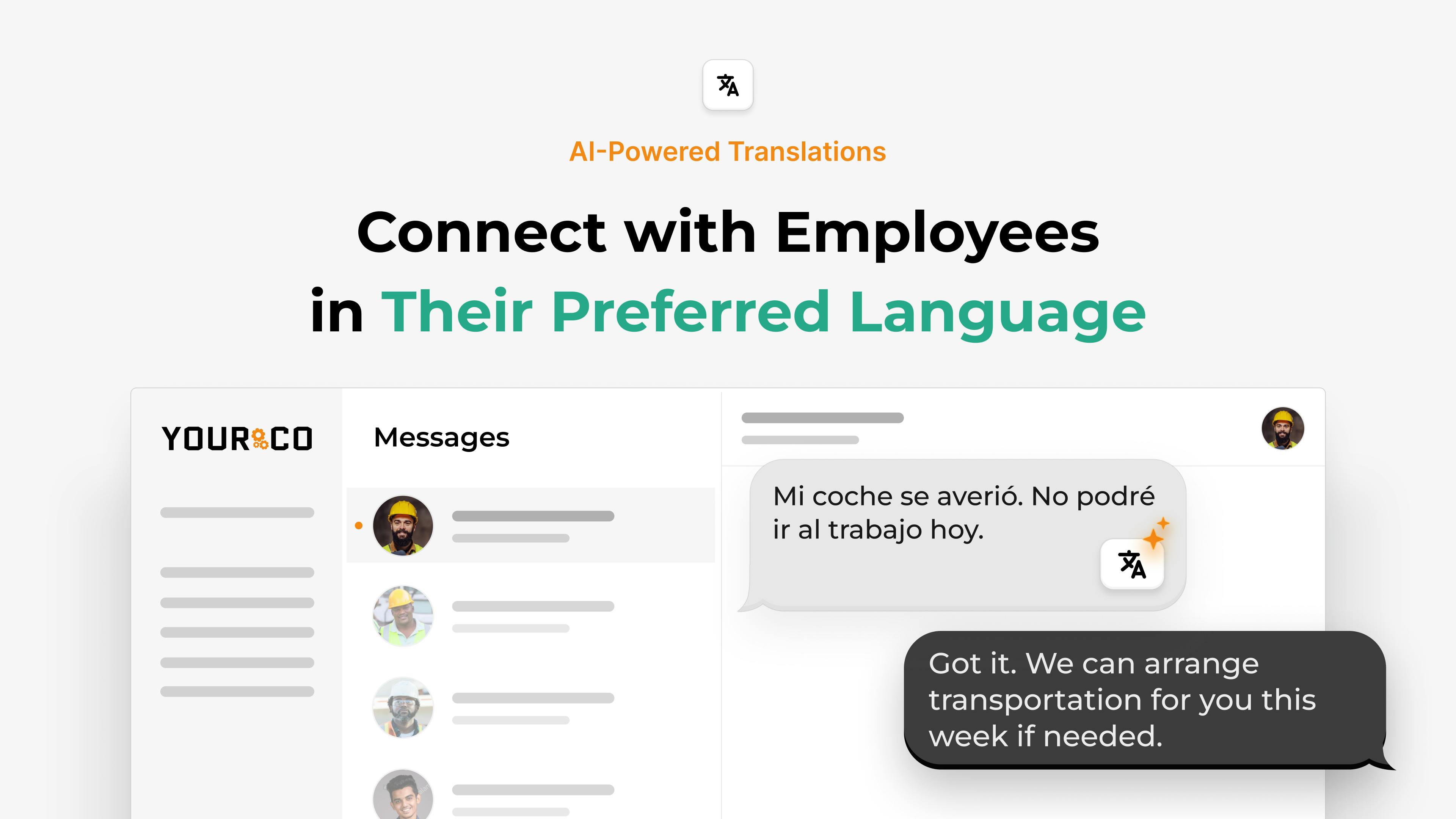
Hospitality workforces are among the most linguistically diverse in the U.S. economy. According to BLS Current Population Survey data, Hispanic or Latino workers make up 39.2% of cooks and 35.0% of dishwashers, while over 80% of hotel housekeeping staff were born outside the United States, according to research from the UC Berkeley Labor Occupational Health Program. Research published in PMC/NIH found that approximately 25% of safety training in restaurants and hotels is delivered only in English, leaving limited-English-proficient workers exposed to hazards they haven't been trained to recognize.
Implementation Steps
- Add "primary language" to every employee record
- Use automatic SMS translation in each employee's preferred language: Yourco translates across 135+ languages and dialects
- Keep sentences short and slang-free; verify comprehension with quick polls before rolling out new policies
- Use pre-built onboarding guides for Spanish-speaking, Tagalog-speaking, Vietnamese-speaking, and Chinese-speaking employees
12. HR and Benefits Enrollment
Goal: Complete paperwork efficiently without overwhelming new hires
Essential Benefits
- Health-insurance choices and enrollment deadlines
- Retirement-plan sign-ups and company matching
- PTO policies and request procedures
- Employee discounts for meals or rooms
Text each task with due dates and short links to forms. Employees confirm their understanding of the policy by replying "YES," which generates a timestamped log. Many employers also ensure required FLSA, OSHA, and EEOC posters are current at each location, according to DOL guidance. For communicating benefits to frontline employees via SMS, see Yourco's dedicated resource.
Ongoing Development
Ongoing development is where hospitality staff onboarding either pays off or falls by the wayside. Organizations with formal onboarding achieve 54% higher new-hire productivity and 50% higher retention than those without one, according to Aberdeen Group research, yet only 32% of companies have a formalized process. A Yourco-commissioned survey of 150 HR leaders found that 88% believe better communication tools can directly reduce employee churn, which means how you communicate through the first 90 days matters as much as what you teach.
13. Performance Check-Ins (30/60/90)
Goal: Address issues before they become problems and build retention
A structured 30/60/90 check-in schedule catches training gaps before they become performance problems. The Corning Glass Works study cited by SHRM found that employees who completed structured orientation were 69% more likely to remain for 3 years.
Check-in structure:
- Day 3: Initial impressions and any first-week confusion
- Week 2: Deeper discussion of role fit and support needs
- 30, 60, 90 days: Formal sit-downs with documented outcomes
Send brief SMS surveys before each meeting to gauge confidence and capture concerns. For a ready-made framework, download the onboarding experience survey template.
14. Feedback Loop and Process Improvement
Goal: Continuously improve your onboarding based on real employee input
Only 12% of employees feel their company does a great job with onboarding, according to Gallup research via SHRM. The same Yourco-commissioned survey of 150 HR leaders found that 92% say improved communication would increase frontline employee engagement, and a feedback loop is the mechanism that makes that improvement visible. Closing the gap requires actively asking for input rather than waiting for exit interviews. Use short, anonymous SMS surveys at post-orientation, day 7, day 30, and day 90. Share "You spoke, we fixed it" updates when changes are made, because that follow-through is what turns a feedback mechanism into a retention tool.
15. Cross-Training and Growth Opportunities
Goal: Build a flexible, engaged team with backup coverage
The Opus Hospitality Training 360 Report 2024 found that helpful training makes restaurant employees 76% more likely to stay, and a cross-trained team absorbs call-offs without scrambling for emergency coverage.
Map essential tasks across departments, schedule shadow shifts via text, and log skills learned for quick shift coverage when call-offs occur.
Onboard Every Hospitality Hire Faster With Yourco
Yourco gives HR directors and hospitality managers a direct SMS line to every new hire from the moment an offer is accepted, with no app downloads, no Wi-Fi, and no cost to employees. Welcome messages, first-day instructions, safety training confirmations, and compliance acknowledgments all move through the same channel every worker already uses.
Core communication capabilities:
- SMS to any phone with no app download, no login, and no cost to employees
- Two-way messaging so new hires can confirm receipt, ask questions, and submit documents directly via text
- AI-powered translation across 135+ languages and dialects, so every onboarding message arrives in each employee's preferred language automatically
Yourco integrates with 240+ HRIS and payroll systems, automatically adding new hires to the right message groups the moment they are created in your HRIS, and removing terminated employees from all active lists in real time.
Enterprise Bridge enables corporate HR and leadership to push one-way onboarding policy updates, brand standards, and compliance directives to every property simultaneously, while local managers maintain direct two-way conversations with their teams.
Frontline Intelligence gives HR and operations leadership centralized visibility into onboarding communication patterns across all locations. It tracks which sites have the strongest new-hire engagement, identifies where welcome messages go unanswered, and surfaces early retention risks before they become turnover statistics.
"Yourco has significantly improved how we connect with employees, making it easier to share important updates, reminders, and announcements in real time. It has become an essential tool in streamlining our internal communication."
— Courtney Martin, Recruiting Manager, The Seagate
After 90 days on Yourco, companies see two-way employee engagement reach 86%.
Try Yourco for free today, or schedule a demo to see the difference the right workplace communication solution can make for your company.
Frequently Asked Questions about Onboarding Checklists for Hospitality Staff
Why does structured onboarding matter so much in hospitality?
Hospitality has an attrition rate nearly twice the national quit rate. Replacing a single restaurant worker costs approximately $6,000, and hotel replacement costs can reach 30% of annual wages. Organizations with strong onboarding practices are up to 103% more likely to see improvements in new-hire retention, which translates directly to lower costs and more consistent guest service.
How can SMS help me train a multilingual team?
Approximately 80% of frontline workers lack a corporate email address, while 84% of U.S. adults with a high school education or less own smartphones. SMS reaches them on a device they already use, and Yourco translates messages automatically into each worker's preferred language. Research shows roughly 25% of safety training in restaurants and hotels is delivered only in English, leaving limited-English-proficient workers exposed to hazards they haven't been trained to recognize.
Which roles need the clearest job expectations?
Front-desk agents, housekeepers, servers, and maintenance staff interact directly with guests every shift, so precise checklists matter most. These are also the roles with the highest language diversity, so expectations need to be delivered in each employee's primary language to be actionable.
What safety topics should every new hire cover?
Start with fire exits, first-aid locations, and incident reporting via SMS. Many employers ensure that chemical and cleaning product training occurs at the start of employment, in accordance with OSHA's Hazard Communication Standard. For housekeeping staff, bloodborne pathogens training is also commonly addressed at the time of assignment. See Yourco's OSHA incident report guide for documentation templates.
How do I stay on top of expiring certificates and documents?
Store licenses, food safety cards and work eligibility forms in a digital dashboard that flags upcoming expirations and sends automated renewal reminders. The ServSafe Food Handler course expires 60 days after it starts, and I-9 retention periods follow USCIS guidance on minimum record-keeping windows.
This information is for general awareness only. For specific compliance guidance, consult with qualified legal professionals.