
SHRM identifies scheduling flexibility as a top retention strategy for frontline workers, and among manufacturers specifically, nearly half (47%) of employers name flexible shift arrangements as their single most impactful retention strategy according to the Deloitte Manufacturing Workforce Report. Shift swaps are one of the simplest ways to deliver that flexibility, but without clear systems, they quickly become the "fire drill every time" that HR directors and operations managers describe when a call-off hits. When implemented correctly, shift swaps give employees more control over their time while keeping your coverage and operations intact. This guide covers everything you need to run a fair, compliant, and efficient shift swap program.
This information is for general awareness only. For specific compliance guidance, consult with qualified legal professionals.
TL;DR
- Shift swaps are a low-cost retention tool that directly addresses the scheduling flexibility frontline workers say they need most.
- Fairness in approvals matters as much as the program itself: inequitable systems hurt morale and create legal exposure.
- A six-step manager workflow covers everything from policy checks to schedule updates and notifications.
- SMS-based platforms are the most practical way to run shift-swap programs for teams without access to computers.
- Fair Workweek laws are expanding rapidly across U.S. cities and states, adding compliance requirements that affect how swaps are managed.
- SMS-based platforms like Yourco make it easy to receive requests, send confirmations, and maintain the audit trail your compliance team needs.
Shift Swap: Definitions, Benefits & Key Risks
A shift swap happens when two employees voluntarily exchange their scheduled work shifts with management approval. It is easy to confuse with related concepts that carry different implications for scheduling, payroll, and compliance:
Understanding these distinctions can help you tackle scheduling conflicts more effectively and apply the right policy to each situation.
Engaged workforces perform better on every operational metric that matters. Gallup's research shows that highly engaged teams experience 78% less absenteeism than their least-engaged counterparts, and engagement is directly tied to schedule control and flexibility. Shift swaps are one of the fastest ways to extend that control to frontline workers without disrupting operations.
You will also see better operational continuity. Instead of scrambling to fill last-minute gaps or paying premium rates for emergency coverage, you maintain consistent staffing through employee-driven solutions. Fairness matters tremendously here. One healthcare provider discovered their informal shift-swap system mainly benefited senior nurses, causing complaints from junior staff about favoritism and requiring HR to rebuild their entire approach from scratch. Your success depends on finding the right balance between flexibility and structure.
Shift Swaps and Why Fairness Matters
Fairness in shift-swap approvals directly affects your program's success and employee retention. When employees see inequity in how managers handle swap requests, team morale suffers, and turnover rises.
Fair systems need transparency and equal opportunities. Practical steps that keep a shift swap program equitable include:
- Rotation systems for popular shifts so that the same employees do not always claim desirable weekend or holiday coverage
- Clear written approval criteria so everyone understands what qualifies and what does not
- Regular pattern reviews to catch potential favoritism before it becomes a morale or legal issue
- Eligibility policies that do not disadvantage newer employees who have not yet built a network of potential swap partners
There is also a legal dimension to fairness that goes beyond morale. The EEOC makes clear that shift-swap approval decisions are effectively shift-assignment decisions, subject to the same anti-discrimination standards as any other scheduling choice. Approvals should not be based on:
- Race, color, religion, or national origin
- Sex or gender
- Age (40 and older)
- Disability or genetic information
Managers should document the stated reason for every denial, not only approvals, and HR should periodically review approval and denial rates by protected class to identify potential disparate impact.
To support fairness and boost morale, consider reviewing compensation strategies for frontline employees that recognize their unique contributions. The JFF American Job Quality Study found that workers without schedule predictability and control rate their job satisfaction a full point lower than workers who have it, a gap that translates directly into retention and productivity.
When Shift Swaps Don't Work
Shift swaps are valuable in most situations, but certain scenarios pose operational problems or legal risks that warrant careful attention. The most common problem areas are:
Last-minute requests. What counts as last-minute varies by industry. Manufacturing facilities typically require 48-72 hours' advance notice due to production planning and safety protocols, while retail environments may handle same-day changes with less friction. Have clear escalation procedures in place before you need them rather than improvising under pressure.
Overtime exposure. Under the Fair Labor Standards Act (FLSA), overtime is generally owed for all hours worked over 40 in a workweek, regardless of how those hours were accumulated through swaps. A simple favor between coworkers can trigger unexpected labor costs without proper monitoring. Always check total weekly hours before approving any swap request.
High-risk scenarios that need extra scrutiny:
- Critical production periods or peak seasons where maintaining team composition matters
- Roles requiring specific certifications or safety credentials where unqualified coverage creates risk
- Employees with existing attendance issues, where swap requests may be masking a deeper reliability problem rather than addressing a genuine scheduling need
For attendance-related cases, the more effective approach is to handle no-shows and address the underlying concern directly.

Manager Workflow: From Request to Approval
This six-step workflow provides a clear framework you can implement right away.
Step 1: Confirm policy allows the swap. Verify the request meets your established criteria: same department, equivalent qualifications, no disqualifying attendance or disciplinary history.
Step 2: Intake the request. SMS platforms like Yourco work best for frontline workers without regular access to computers. Paper forms work for smaller teams but create extra administrative work.
Step 3: Run labor law and overtime checks. Verify the arrangement does not push either employee over 40 hours for the week. Confirm adequate rest periods between shifts and check state-specific break requirements. In jurisdictions with Fair Workweek laws, verify that the swap does not conflict with the posted advance schedule in a way that would trigger predictability pay.
Step 4: Route to the appropriate approval level. Include employee names, shift details, the reason for the change, and your compliance verification. Some organizations allow supervisors to approve routine requests while requiring higher-level approval for holidays or critical periods.
Step 5: Update the live schedule. Once approved, immediately update all scheduling systems to prevent payroll errors and ensure data consistency across integrated platforms.
Step 6: Send notifications and archive. All affected parties should receive confirmation: both employees, their supervisors, and any support staff with schedule visibility. According to DOL recordkeeping requirements, many employers retain payroll records for at least 3 years, and time records for at least 2 years.
Managing Frontline Team Shift Swaps via SMS
Traditional shift-swap methods fail frontline workers who spend their days on factory floors, construction sites, or delivery routes. Email systems and company intranets are useless when employees lack access to computers, and workers often miss phone calls during busy periods. This communication gap leads to unfilled shifts, last-minute scrambles, and frustrated managers. According to a Yourco-commissioned survey of 150 HR leaders, 91% say SMS increases frontline employee response rates, making it the most practical channel for coordinating and confirming swaps in real time.
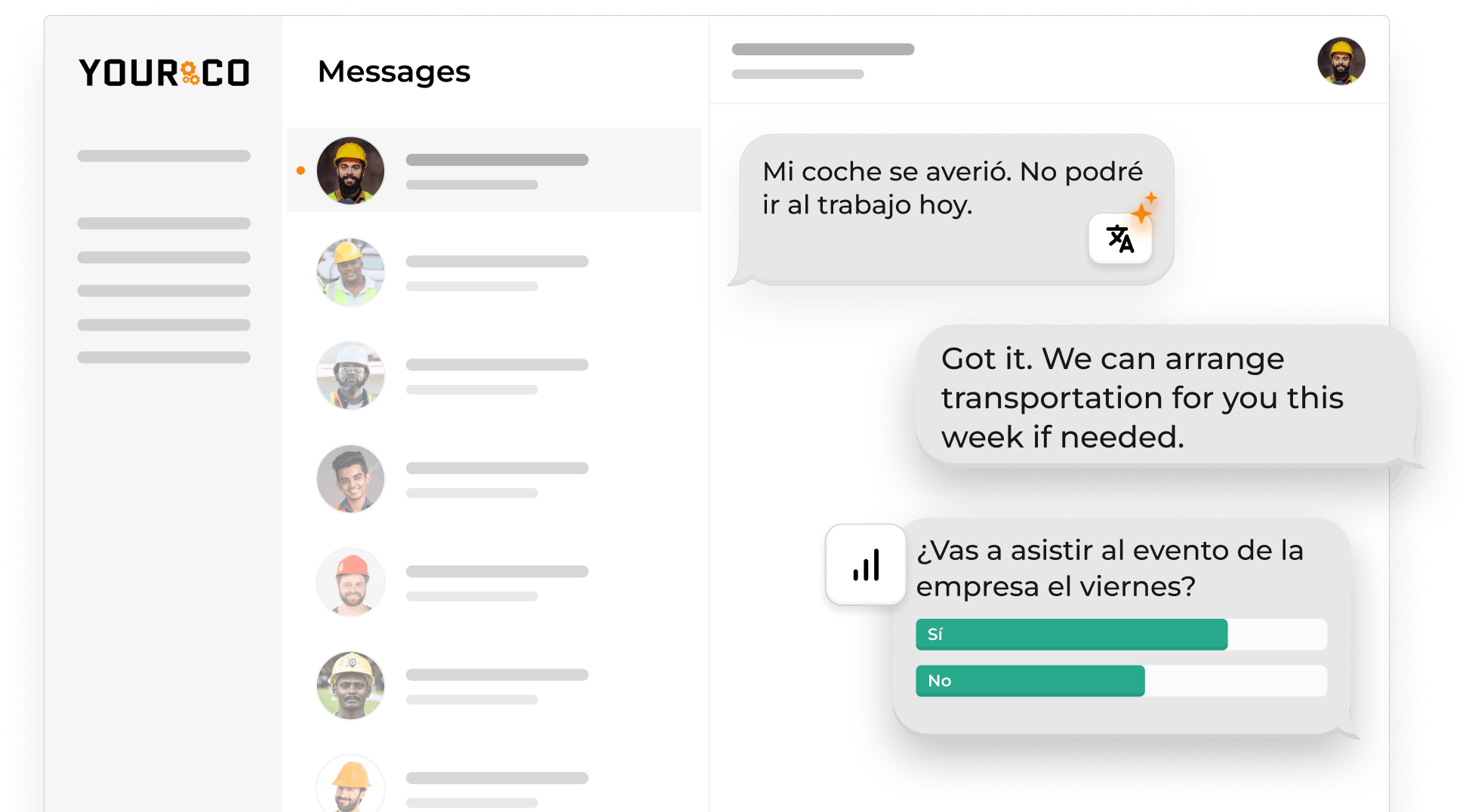
Text-based platforms solve this problem by reaching employees wherever they work. Yourco works on any phone, without requiring smartphones or reliable data connections, removing technology barriers and ensuring every team member can participate regardless of device or comfort level with technology. Multilingual support across 135+ languages ensures clear communication for diverse workforces and helps overcome language barriers that often complicate shift coordination.
Managers can send shift-swap announcements, receive requests, and provide approvals all through simple text exchanges. Every interaction is automatically time-stamped and logged, creating the audit trail needed for compliance while streamlining the entire process. This transforms shift-swap coordination from a time-consuming burden into an efficient, employee-driven system that works across all shifts and locations. See managing shift changes effectively for implementation guidance.
Building a Fair and Compliant Shift Swap Policy
A solid shift swap policy is the foundation for maintaining fairness and operational continuity. SHRM research finds that five of the top seven most effective retention strategies for hourly workers relate directly to scheduling, yet the most impactful scheduling tactics are offered by only one-third of employers. A well-documented shift swap policy is one of the fastest ways to close that gap.
A complete policy should address:
- Eligibility requirements: Restrict swaps to employees within the same department or position who have equivalent training, experience, and performance levels. In manufacturing, this means identical safety certifications; in healthcare, equivalent clinical credentials.
- Approval hierarchy: Require supervisor approval for all shift swaps to maintain management visibility into schedule changes.
- Notice periods: Manufacturing facilities often require 48-72 hours' advance notice; retail may allow shorter windows. Always include provisions for genuine emergencies.
- Documentation: Record all requests, approvals, denials, and the reasoning behind each decision. This audit trail satisfies DOL recordkeeping requirements (at least 2 years for time records and 3 years for payroll records) and protects against discrimination claims.
- Blackout dates: Restrict or apply additional scrutiny during peak business periods, inventory counts, or major project deadlines.
- Overtime limits: Build in automatic checks that prevent swaps from pushing employees over 40 hours per week unless specifically approved.
- Consistent enforcement: Train supervisors on approval criteria and document the reason for every denial in accordance with EEOC guidance.
Legal and Labor Law Considerations for Shift Swaps
Shift-swap decisions carry real legal exposure across federal, state, and local levels. The areas below represent the most common compliance considerations HR teams should map before finalizing a shift swap policy.
Overtime under the FLSA. Under the FLSA, overtime is generally owed for all hours worked over 40 in a workweek, calculated independently; averaging hours across two weeks is not permitted, regardless of how those hours were accumulated through swaps. Review FLSA regulations (29 CFR § 553.31) for specific language on voluntary substitutions. A limited public-sector exception exists for state and local government employees, but this provision does not apply to private-sector employers.
State-specific breaks and overtime. States such as California have established meal and rest period requirements that generally apply after swaps. California also applies overtime after 8 hours worked in a single day, not just 40 in a week, meaning a swap that moves an employee into a longer shift can trigger daily overtime even when the weekly total stays under 40 hours. A state-specific review is considered good practice before finalizing any state swap with daily overtime thresholds.
Predictive scheduling and Fair Workweek laws. No federal predictive scheduling law exists as of 2026, but a growing patchwork of state and local jurisdictions has enacted Fair Workweek ordinances that directly affect how shift swaps are managed. Active jurisdictions as of April 2026 include:
Additional active jurisdictions include San Francisco, Emeryville, San Jose, Berkeley, Evanston (Illinois), and Washington, D.C. The general penalty range across these laws is $300- $1,000 per violation, per employee, per day. Note that twelve states, including Alabama, Georgia, Indiana, and Michigan, have passed legislation preempting local scheduling ordinances. In all covered jurisdictions, obtain written consent before adding shifts after a schedule has been posted, and maintain the required scheduling records.
Anti-discrimination. Because swap approval decisions are functionally shift assignment decisions, they are subject to the same anti-discrimination standards as any other employment action under EEOC guidance. Specifically regarding religious accommodation requests, the EEOC's position is that employers cannot automatically deny a religiously motivated swap request solely due to potential overtime costs.
Collective bargaining agreements. Union contracts may override company policy entirely. Under NLRB Section 8(d), shift scheduling is a mandatory subject of bargaining. Before finalizing any shift swap policy in a unionized environment, review your CBA for:
- Seniority clauses that may give senior employees priority in accepting or refusing swaps
- Overtime equalization requirements that affect how extra hours are distributed
- Job classification restrictions that limit who can swap with whom
Simplify Shift Swaps With Yourco
Effective shift swap programs depend on a communication channel that reaches every worker, confirms every request, and automatically documents every decision. Yourco is purpose-built for exactly that: no app download required, works on any device, including flip phones, and automatically translates messages into 135+ languages so every employee receives swap notifications in their preferred language. Core capabilities include:
- SMS to any phone, with no app or Wi-Fi required
- Two-way messaging for swap requests, manager approvals, and real-time confirmations
- Automatic time-stamping of every interaction for compliance documentation
- AI-powered translations across 135+ languages and dialects
- Centralized dashboards for visibility across shifts, departments, and sites
Yourco connects with 240+ HRIS and payroll systems, so schedule updates sync automatically into the systems your HR and payroll teams already use. Enterprise Bridge enables corporate leadership to send centralized, one-way scheduling policy updates across all locations simultaneously, while local managers maintain direct communication with their teams.
Frontline Intelligence provides HR and operations teams with centralized visibility into shift-swap patterns, response times, and coverage gaps across all locations. Leaders can identify which sites have the most last-minute requests, see where swap denials are concentrated, and surface patterns that may signal scheduling policy issues before they affect coverage or compliance.
"We use Yourco for our absence management and for sending out notices, reminders, and event announcements. It keeps everyone who needs to know informed when people are absent."
— Kyle Stover, HR Assistant, J-Lenco Inc.
After 90 days on Yourco, companies see two-way employee engagement reach 86%.
Try Yourco for free today, or schedule a demo to see the difference the right workplace communication solution can make for your company.

Frequently Asked Questions about Shift Swap
What if no one picks up a shift?
Give employees 24-48 hours to claim an opening, then escalate to management for alternative coverage. If no one steps up, the original employee remains responsible unless management approves the absence. Keep the coverage process as frictionless as possible: overly complicated systems push employees toward no-call no-shows rather than legitimate shift coordination.
Does a shift swap that increases hours beyond 40 count as overtime?
Under the FLSA, overtime is generally owed once an employee works more than 40 hours in a workweek, regardless of how those hours were scheduled or swapped. The workweek is calculated independently with no averaging across pay periods.
How do you deny a shift swap fairly?
Apply objective criteria consistently: adequate notice, skills match, coverage requirements, and overtime thresholds. Document the specific reason for every denial, not just approvals. Consistent documentation protects against discrimination and retaliation claims and is required in several Fair Workweek jurisdictions.
Can employees with different skill levels swap shifts?
Only if both employees meet the minimum qualifications for each other's positions. In manufacturing, this means identical safety certifications; in healthcare, equivalent clinical credentials. SMS-based platforms like Yourco can help managers quickly confirm qualification matches before approving any swap.
How do you handle employees who consistently avoid certain shifts through swaps?
Monitor patterns, set frequency limits on swaps for specific shifts, and address potential abuse through coaching before considering disciplinary action. Consider rotating assignments for consistently hard-to-fill shifts so no single employee bears a disproportionate burden.
How quickly should managers respond to shift-swap requests?
Aim to respond within 24 hours. In jurisdictions with active Fair Workweek laws, such as Chicago and Evanston, local ordinances generally require employers to notify employees of acceptance or rejection within 3 days. Building a clear escalation path for urgent requests into your policy prevents delays from becoming compliance issues.