
After pay, schedule flexibility is the second most important factor in whether frontline employees stay or leave their jobs, according to a UKG survey of frontline workers across 10 countries, yet 50% say they find it difficult to change shifts when a personal issue arises. Scheduling sits at the center of both the problem and the fix.
This guide covers how to identify and resolve the most common scheduling issues before they become a turnover problem.
TL;DR
- Scheduling problems fall into four categories: shift conflicts, understaffing, no-shows, and inconsistent hours
- Predictive scheduling, giving workers at least 14 days' notice, directly reduces no-shows and improves retention
- Giving employees input into their schedules is one of the highest-return retention investments HR can make
- Fair workweek laws now apply in several major jurisdictions and carry real enforcement consequences
- SMS-based platforms like Yourco ensure every frontline worker receives schedule updates, even without a smartphone or company email
Identifying Common Scheduling Issues
Scheduling problems in frontline industries fall into four categories. Understanding which one you're dealing with determines which fix will actually work.
Shift Swapping and Scheduling Conflicts
When employees can't predict their hours, they can't plan their lives around them. That leads to last-minute conflicts, missed shifts, and informal swaps that bypass the scheduling system entirely.
A Harvard Business School (HBS) study analyzing over 28 million time card records for retail shift workers found that 37% of shifts had materially inconsistent start times from week to week, and in those shifts, 16% of workers were late or absent.
The fix is a documented shift exchange process that gives employees some agency while preserving manager oversight. Organizations that build this in see fewer no-shows, not because employees suddenly become more reliable, but because the schedule stops being the reason they're not.
Understaffing and Overstaffing
Too few workers means mandatory overtime becomes the default patch. Too many means avoidable labor costs and lower per-employee productivity. Both problems trace back to the same root cause: scheduling based on headcount assumptions instead of actual attendance patterns.
Sedgwick's 2025 data estimates that lost productivity from absenteeism can reach $11,000 per employee per year, before accounting for overtime or the onboarding of replacement workers. At a 500-person operation, even a 3% absence rate means roughly 15 workers are unexpectedly absent on any given day.
Managers who build historical attendance data into their forecasting, accounting for known high-absence days, seasonal peaks, and local patterns, make significantly more accurate staffing decisions than those who rely on standard headcount assumptions.
Time Management and No-Shows
No-shows are the most operationally disruptive scheduling problem. A single absent worker does not just create a coverage issue; it redistributes the workload among whoever shows up, drives up overtime costs, and compounds quickly when it occurs on the same shifts week after week.
The same HBS study found that when a start time varies by more than one hour from the prior week, tardiness increases by 21.3 % points and no-shows by 32.9 % points. Employees who don't know their schedule can't arrange transportation, childcare, or secondary income.
85% of HR leaders say improved communication would reduce absenteeism, according to a Yourco-commissioned survey of 150 HR leaders. Simple confirmation systems where employees acknowledge upcoming shifts via text message are among the lowest-effort, highest-impact interventions available. Tracking absence patterns over time also surfaces the real causes before they become termination conversations.
Inconsistent Scheduling
Inconsistent scheduling is one of the most common and most underaddressed drivers of frontline burnout. "Clopening" shifts, closing late and opening early with fewer than 11 hours of rest in between, are experienced by more than 1 in 3 hourly service workers, according to the National Women's Law Center (NWLC).
Research cited by the Occupational Safety and Health Administration (OSHA) links long hours and irregular schedules to fatigue-related workplace injuries, with accident rates 18% higher on evening shifts and 30% higher on night shifts compared to day shifts. Cumulative fatigue risk increases across consecutive shifts, significantly increasing the overall injury probability.
Solutions to Scheduling Issues
Effective solutions require combining the right tools, policies, and communication infrastructure. The most reliable organizations address all three together.
Implementing Scheduling Software
Modern scheduling tools can improve both productivity and employee satisfaction when chosen with the actual workforce in mind. For frontline workers who may not have smartphones, company email, or reliable internet, the technology has to meet employees where they are.
Features that matter for frontline operations:
- Real-time schedule visibility so workers can check shifts without calling a manager
- Conflict detection that flags double-booking and shift gaps before they become coverage problems
- Shift swap tools that give workers options while keeping manager oversight intact
- Attendance tracking tied to the schedule rather than managed separately
- Payroll integration to ensure accurate compensation when shifts change
The key question when evaluating any scheduling tool: Will every employee on the roster actually be able to use it? A tool that requires an app download or a company account creates a two-tiered information environment. The tier without access will have worse attendance and higher turnover.
Employee Feedback and Collaboration Tools
Giving employees meaningful input into their schedules is one of the highest-return investments HR can make. 66% of service-sector workers say they would prefer a more stable schedule, according to The Shift Project, a Harvard and UC Berkeley research initiative tracking hourly workforce conditions.
What most workers want is predictability and some input, not a specific structure. Digital shift-swap tools reduce administrative burden while giving workers that control. Anonymous employee surveys surface scheduling problems before they lead to absences.
Predictive Scheduling and Flexibility
Predictive scheduling means giving employees at least 14 days' advance notice of their schedule. It directly reduces no-shows, strengthens retention, and in a growing number of jurisdictions, it is a legal requirement. The operational benefits follow predictably: workers who know their schedule in advance show up more reliably, plan their lives around their hours, and stay in roles longer.
For multi-location employers, fair workweek compliance is increasingly complex. The Fair Labor Standards Act (FLSA) does not cover schedule notice, but a patchwork of state and local laws does. Requirements vary by jurisdiction:
This table covers general awareness only. For jurisdiction-specific guidance, consult qualified employment counsel.
Emergency Preparedness and Backup Systems
Even well-run operations face same-day call-outs; hence, the question is whether the organization has a system in place for them.
Effective backup coverage comes down to three operational requirements:
- An up-to-date coverage list that managers can reach on short notice
- A communication channel that gets to workers immediately, not buried in email
- Employees who already know the coverage process before the 6 am request arrives
Tracking absence patterns over time converts reactive scrambling into proactive staffing.
Improving Communication and Engagement
A well-designed schedule still fails if workers don't receive it, don't understand it, or can't flag a problem with it. For frontline teams without company email or computer access, this is the core challenge, not a secondary one.
Transparent Scheduling Processes
When employees understand how scheduling decisions are made, there is less resentment, fewer informal workarounds, and better attendance. Here are three policy areas worth documenting clearly:
- Time-off requests: How workers submit them, how far in advance, and how decisions are communicated
- Shift assignment logic: How shifts are distributed, whether seniority or availability drives it, and what changes that
- Schedule change procedures: Who approves changes, how much notice is standard, and how confirmation is recorded
Gallup finds that employees who clearly understand what is expected of them are 47% less likely to experience frequent burnout and 23% less likely to report work-life balance problems. Both outcomes trace directly to how clearly scheduled expectations are communicated and maintained.
Mobile Access for Frontline Workers
For workers without company email or intranet access, SMS is the only channel that reliably gets through. Text messages carry open rates near 98% compared to 20% for emails, and SMS works on any mobile device without an app download, data plan, or company account.
91% of HR leaders report that SMS use increases frontline employee response rates, according to a Yourco-commissioned survey of 150 HR leaders. SMS-based platforms for scheduling updates like Yourco handle the full range of frontline scheduling communication needs:
- Shift reminders are sent directly to any phone before the start of each workday
- Schedule change broadcasts that reach the entire team or specific groups instantly
- Shift confirmation collection so managers have documented acknowledgment, not verbal assumptions
- Two-way conversations for coverage requests without routing everything through a manager's personal number
Education and Training
Scheduling systems break down when managers or employees don't know how to use them. This is especially true for frontline teams with high turnover and varied technology backgrounds.
Effective training does not need to be complex. Three low-effort steps make a measurable difference:
- Short guides distributed at shift change covering how the scheduling system works
- A designated scheduling coordinator on each team who fields questions and flags problems early
- Clear instructions for reporting absences, requesting swaps, and flagging conflicts before they become no-shows
Organizations hiring non-English-speaking employees need to ensure that scheduling, communication and training materials are accessible across language barriers. A missed shift caused by a misunderstood schedule change is a communication failure, not an attendance problem.
Applying SMS Communication to Scheduling Challenges
The communication infrastructure behind scheduling matters as much as the schedule itself. SMS-based platforms like Yourco ensure every employee can receive and respond to scheduling information regardless of internet access, device type, or language.
These are the four common applications across a typical scheduling workflow:
When every employee on the roster gets the message, the most common reason schedules fail is eliminated.
Resolve Scheduling Issues Faster With Yourco
42% of voluntary employee turnover is preventable, and scheduling sits at the center of most of it. Work Institute's 2025 Retention Report found that 76.3% of all exits are preventable. The majority stems from fixable scheduling and communication practices.
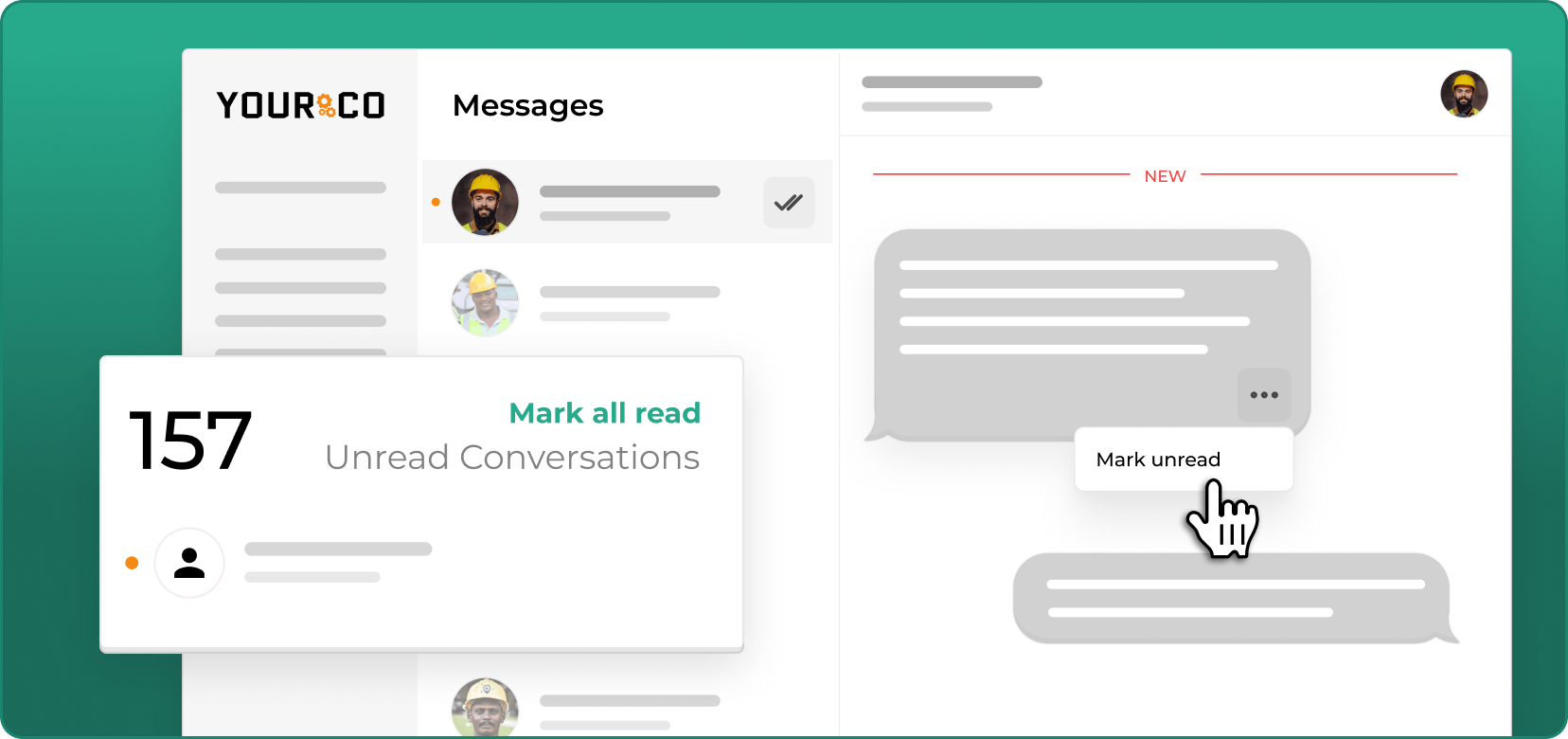
Yourco is an SMS-based employee communication platform built for frontline workforces. It removes the communication barriers that cause scheduling systems to break down at the last mile.
Yourco's core scheduling communication capabilities include:
- SMS to any phone: No app download, no WiFi, no data plan required, at no cost to employees. Works on smartphones and basic flip phones alike.
- Two-way messaging: Employees confirm shifts, flag conflicts, and reach HR directly without a company email address.
- AI-powered translation: Covers 135+ languages and dialects, so multilingual teams receive scheduling communications in their preferred language.
Yourco integrates with 240+ HRIS and payroll systems, keeping roster data up to date so that schedule changes reach the right employees automatically.
Enterprise Bridge enables operations leadership to send centralized schedule broadcasts across all locations while site managers maintain direct communication with their teams.
Frontline Intelligence gives HR and operations teams centralized visibility into attendance patterns, shift confirmation rates, and call-off activity across all locations. Leadership can identify which sites have the highest unplanned absence rates, flag which shifts drive the most coverage failures, and generate reports that support proactive workforce decisions.
"We use Yourco for our absence management and for sending out notices, reminders, and event announcements. It keeps everyone who needs to know informed when people are absent."
— Kyle Stover, HR Assistant, J-Lenco Inc.
After 90 days on Yourco, companies see two-way employee engagement reach 86%.
Try Yourco for free or schedule a demo to see how SMS-based scheduling communication can reduce no-shows, improve coverage, and reach every employee on your roster.
Frequently Asked Questions About Employee Scheduling Issues
What are the most common employee scheduling issues in frontline industries?
The most common scheduling issues are shift-swap conflicts, unpredictable schedules, understaffing due to poor attendance forecasting, and no-shows driven by erratic start times. Schedule predictability is the highest-leverage fix for most operations, with research showing that start-time inconsistency alone increases no-shows by more than 32%.
How does predictive scheduling reduce employee turnover?
Predictive scheduling gives employees the advance notice they need to plan transportation, childcare, and secondary income. SHRM research identifies it as one of the most effective frontline retention strategies, yet fewer than 1 in 3 employers use it. Stable schedules also correlate directly with lower absenteeism and stronger team cohesion over time.
What are fair workweek laws, and which employers need to comply?
Fair workweek laws are state and local regulations that require advance notice of schedules, predictability premiums for last-minute changes, and a first right to additional hours for existing employees before new staff is hired. They apply across New York City, Chicago, Los Angeles County, and several other jurisdictions, generally targeting retail, hospitality, and food service employers with a certain size threshold. Requirements vary significantly, so multi-location employers should review obligations on a jurisdiction-by-jurisdiction basis with employment counsel.
How can SMS improve frontline scheduling communication?
SMS reaches any mobile phone without app downloads, company email, or internet access. For frontline workers who rarely access corporate systems, a text is often the only reliable way to confirm a shift, report an absence, or receive a last-minute change. Two-way SMS platforms like Yourco provide managers with documented confirmation rather than informal verbal agreements.
What is the operational cost of poor scheduling and communication?
Poor scheduling and communication drive overtime when coverage fails, turnover when workers feel uninformed, and compliance liability when changes aren't documented. Improving how scheduling information reaches workers is one of the few interventions that reduces all three simultaneously.